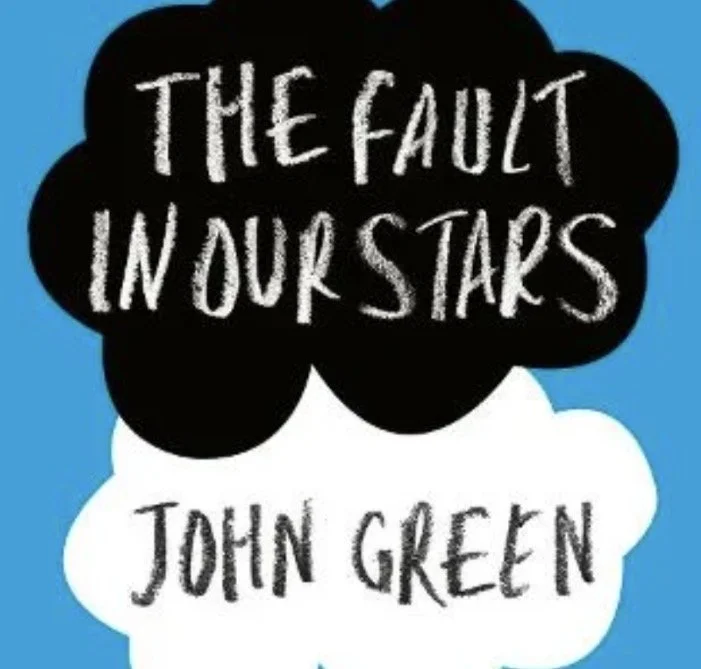
The Fault In Our Stars - John Green
Trigger warnings: terminal illness, grief, death.
The Fault In Our Stars by John Green is a young adult fiction book about 2 teenagers that meet during a cancer support group, written from Hazel Grace Lancaster’s point of view. She has been diagnosed with thyroid cancer since she was a child, and has been lucky to find an experimental drug that suppresses her tumours to develop further. Hazel still has to carry around an oxygen tank to assist her breathing, attend regular hospital appointments, take medication multiple times a day, and attends a college each week. Enter Augustus Waters: a cancer survivor and amputee who attends the same support group as Hazel on behalf of their mutual friend Isaac, whereby they challenge each other over the idea of oblivion, and being remembered forever. Despite opposing views, and Hazel’s aversion to affection, they bond over her favourite novel ‘An Imperial Affliction’, and take a trip together to Amsterdam to meet the author.
——————————————————————————————————————————Spoilers ahead———————————————————————————————————————————
Overall, I believe the theme of the Fault In Our Stars to be those that are left behind. Throughout the book, we see Hazel feeling sorry for her parents as she contemplates what will happen to them when she succumbs to her illness, how Peter Van Houten is left after the passing of his daughter at the age of 8, how Isaac is abandoned by his ex-girlfriend once he has his surgery which leaves him blind, and how Hazel is then left alone after Augustus passes away, alongside his family and friends. At the beginning of the book, Hazel often expresses how she doesn’t want to blow up like a grenade because she knows that when she passes it will have a ripple effect on any romantic partner she would have, specifically Gus -
“I’m a grenade and at some point I’m going to blow up and I would like to minimize the casualties, okay?”
- when in actual fact, he becomes the grenade in a sense. Hazel consistently worries about her parents, especially her mum, ever since she heard her say in the ICU when she was struggling to breath, that she ‘wouldn’t be a mum anymore’. This understandable sticks with Hazel throughout the book, and worries that when she is attending her support group her mum waits in the car park for her, and ‘hovers’ around her all the time in case something happens to her. Understandably, Hazel’s mum shows throughout the book that when Hazel shouts or exclaims, she immediately runs to her side. However, when it’s revealed that she is working towards getting her social degree to help those that have been through similar circumstances of living with a child with a terminal diagnosis. Again, the idea that Hazel’s mum will also go on to help affected others adds to the theme of those that live on, and Hazel is very happy to hear that this is what her mum has been working towards. Its the first time when we see that despite grief, life goes on.
“You of all people know it’s possible to live with pain.”
I particularly love this quote as it can be interpreted as the literal pain that Hazel faces every day with her condition, and how she persists every day to get up and go to college and try her best to live a ‘normal’ life. But also, we know that her mum means the pain of losing someone you love, and that eventually you learn to live with it, and carry on. As I said before, Hazel is so concerned about hurting Augustus when she will pass away, that she doesn’t think about the fact that Gus wants to be there for her regardless. Similarly to how she goes on to care for him when he becomes fatally sick, regardless.
When Augustus finds out that he is dying, he is still concerned about the idea of oblivion, the second theme of the book. Gus says that becomes his time has been cut short, he doesn’t have time to be remembered, or to do a heroic act that people will write about. Hazel Grace argues that she will remember him, and that this will be enough, which at the time, I still don’t believe that he understands. As a young person, I idea that the idea of being remembered once he passed was comforting to him, almost as if he wasn’t really dead because people still spoke of him. I think that as Augustus believed that he would have more time to live, and that the thought about not growing old terrified him. Eventually he is comforted by Hazel who changes his mind about this concept, which he speaks of in his letter to Peter Van Houten at the very end of the book -
“People will say it’s sad that she will leave a lesser scar, that fewer remember her, that she was loved deeply but not widely. But it’s not sad Van Houten. It’s triumphant. It’s heroic.”
Augustus in his final moments understands that he was deeply loved by his family, friends and Hazel Grace. He understood that despite the fact he wouldn’t be remembered by everyone on this earth, he would be remembered by people that meant the most to him which in itself was marking his mark. Hazel also speaks of this in the eulogy that she shared with Gus and Isaac, whereby she talks about their ‘little infinity’. She says that even though they’re relationship was short, and that people have long partnerships, marriages etc. that last a lifetime (an infinity), that they’re love should not be dismissed because it took place over some months when they were young. I believe that it’s the same idea of the relationship between Romeo and Juliet when it’s argued that they’re love was unbelievable and was undeserving of that passion because of their age - but I highly disagree. I think that people would often dismiss young love because their not mature enough to understand, but Hazel and Gus were almost forced to grow up because of their terminal cancer. They are more adult than lots of people that would live to be twice their age because they had no choice. Because of this, I truly think that they knew that this love was important, and that it should not be ignored the marks that people can leave on you in such a short space of time.
“You gave me a forever within the numbered days, and I’m grateful.”
I also loved the comparison between the key points of ‘An Imperial Affliction’ with Hazel’s story. Hazel Grace believes that she is very similar to the main female character Anna as she is also diagnosed with terminal cancer, but unfortunately she will never know the true ending as the book finishes mid-sentence. She becomes infatuated with the idea of finding out the ending, and what happens to the secondary characters, which again ties in with the obsession with what happens to those left behind. Hazel assumes that Anna becomes too sick to continue or passes away, almost as if she doesn’t place any thought in what happens next, only those that carry on after. This helps us to understand why Hazel worries about her mum so much, and is very happy when she finds out what she plans to do when Hazel dies.
However, when Hazel Grace and Augustus Waters go to Amsterdam, author of ‘An Imperial Affliction’ Peter Van Houten, has no answers for his fans that have travelled all that way for closure. The way in which he acts towards the teenage couple is almost an answer within itself: the people left behind afterward struggle to cope, may turn to substance use, act poorly, have little empathy and ultimately may even become horrible people. Houten’s assistant Lidewij says that ‘circumstance has made him cruel’ explaining that he is this way because of losing his daughter. I also think that his behaviour is exaggerated because Hazel reminds Peter of his daughter and is another reminder that she won’t grow up to be Hazel’s age, causing him to take out his anger on them her and Gus. Even though there is no excuse for how he treated them, it shows the other side of what can happen to those that are left behind, and I believe is what will have inspired Hazel to carry on living after Augustus’ death.
Overall, I think that this book is so incredibly inspiring. The idea that even though we can suffer pain, both physical, emotional and mental, but we can and will keep going. That with loss comes endurance, bravery and ultimately love that we leave others with when we’re gone. Personally, this book has helped me with my fear and anxiety surrounding death. I know that it comes for us all eventually, some sooner than others, but it’s about what we do while we’re here that matters. Our lives will have a ripple effect that will never will be able to comprehend, and that all we can do is love deeply. I highly recommend this book to anyone that enjoys meaningful young adult books, and anyone who needs help in understanding and processing grief and death. I hope it helped you the way it helped me.
Rating: ∞ stars.
